About Comm-Piler
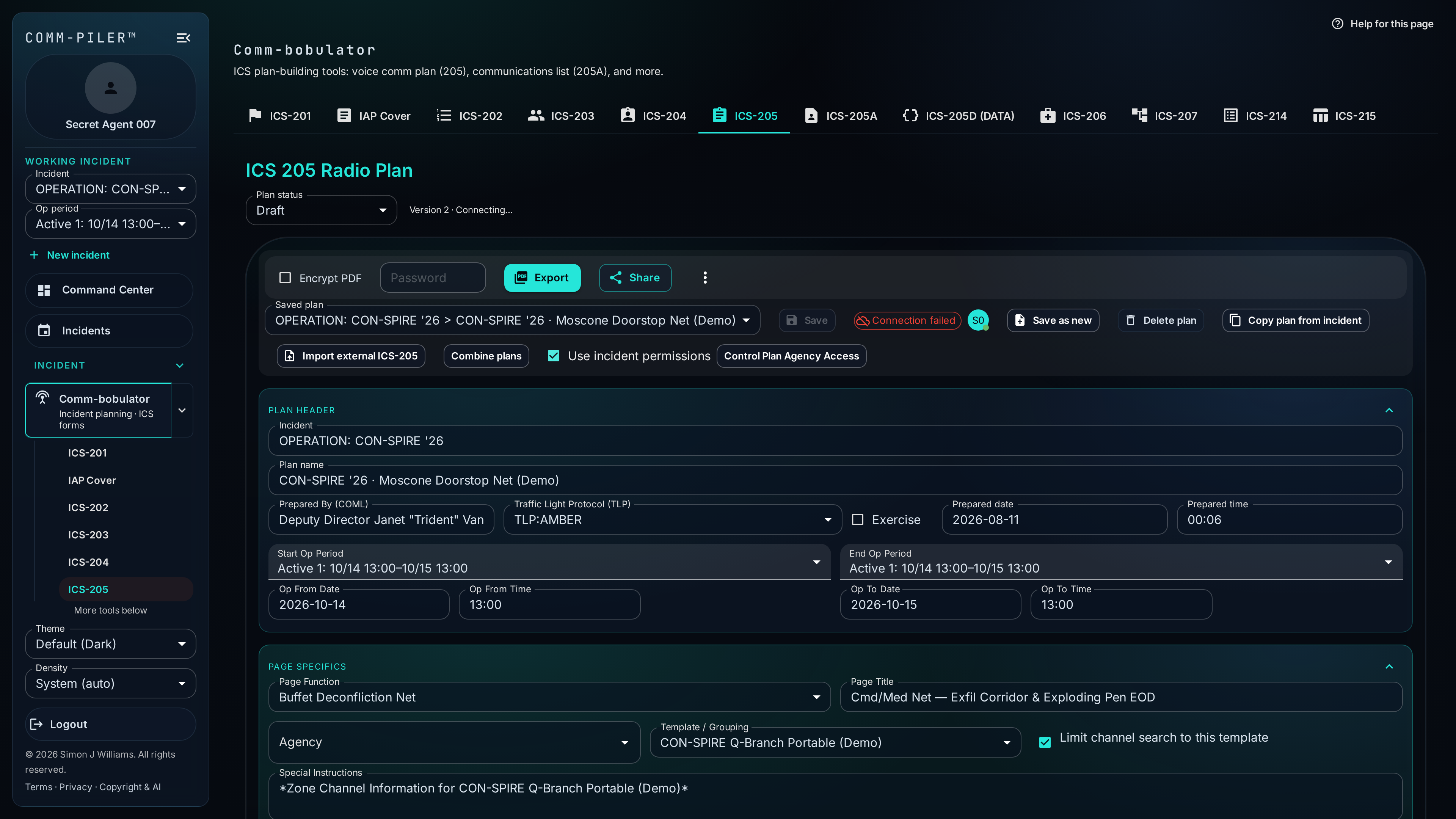
Comm-Piler is a web-based software application for planning incident communications. Public safety communications units use it to build ICS-205 (Incident Radio Communications Plan) and ICS-205A (Communications List) forms and related Incident Action Plan documents, then export them as print-ready PDFs.
Who operates it
Comm-Piler™ is developed and operated by Simon J Williams, a sole proprietor in California, United States. It is independent software; it is not a government website and is not endorsed by any government agency.
Who uses it
Communications Unit Leaders (COML), Communications Technicians (COMT), incident management teams, emergency operations centers, and public safety agencies that follow the National Incident Management System (NIMS) and Incident Command System (ICS).
What it does
- Maintains a structured library of radio channels, talkgroups, aliases, and trunking systems for each agency.
- Builds ICS-205 and ICS-205A plans from that library so frequencies, tones, and modes are entered once and reused.
- Produces the wider Incident Action Plan form set (ICS-201 through ICS-215, safety forms, ICS-209 status summaries).
- Maps plan channels onto programmed radio templates (zone and channel positions).
- Searches public FCC license and antenna-structure records to support frequency coordination.
- Supports PACE (Primary, Alternate, Contingency, Emergency) planning, equipment cache tracking, and helpdesk workflows for incidents.
What data it handles
Radio system configuration (frequencies, tones, talkgroups), incident and planning documents, and responder contact details (names, roles, phone numbers, email) entered by authorized users. It does not handle classified information, Criminal Justice Information (CJI), Social Security numbers, or payment card data. Each organization's data is private to that organization. See the Privacy Policy.
How access works
Comm-Piler is a sign-in application. New accounts are requested through the sign-up form and approved by an administrator before use. A small number of intentional sharing links (for example, a published plan shared with a mutual-aid partner) use long random tokens and optional passwords.
Contact
Simon J Williams, operator
Email: [email protected]
(alternate: [email protected])
Security reports: see Security and vulnerability disclosure.